
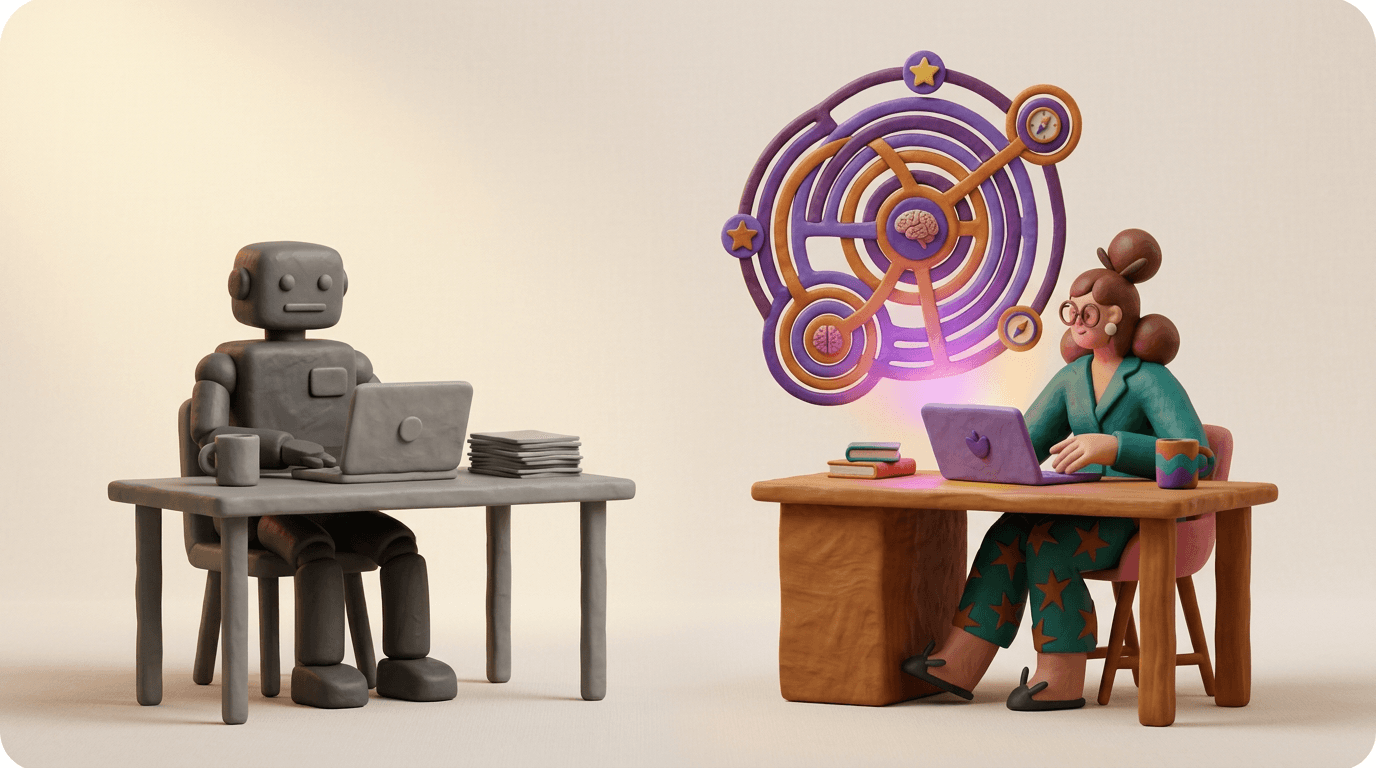
ChatGPT is a great general assistant and now has memory across conversations. NAVRYN is built for one job: understanding your patterns. The real difference is the kind of context each carries. ChatGPT accumulates context loosely from what you mention. NAVRYN starts from a validated personality assessment across 11 frameworks, so its coaching is structured and personalised from your first session, then deepens over time.
This is a fair question, and we hear it often: "I can already talk to ChatGPT about my problems. Why would I use NAVRYN?"
The honest answer is that ChatGPT is a remarkable tool. It's one of the most versatile AI products ever built. But versatility and coaching are different things. A Swiss Army knife is incredibly useful - but you wouldn't use it to perform surgery.
Let's walk through what actually differs, and why it matters when the goal is understanding yourself.
The context problem
ChatGPT has memory now. It's on by default for most accounts, and it carries context from one conversation to the next. So the old "it forgets you every time" critique no longer holds. Credit where it's due.
But there are two kinds of context, and the difference matters for coaching.
ChatGPT's memory accumulates loosely. It picks up whatever you happen to mention, in whatever order you mention it. Over months that builds a scattered, partial picture, shaped more by what you talked about than by who you are.
NAVRYN's context is structured. It starts from a validated personality assessment across 11 frameworks, so the coaching is personalised from day one, before you've explained anything. It already knows how you tend to handle conflict, make decisions, and respond under stress. Then it builds on that foundation, connecting today's frustration to the pattern underneath it. (Here's more on why persistent, structured context changes what coaching can do.)
So the real distinction isn't memory versus no memory. It's loose accumulation versus a validated, structured profile. Coaching depends on the second kind. A good coach doesn't just remember what you said three weeks ago. They understand the wiring that produced it.
Personality Awareness vs. General Knowledge
ChatGPT knows a lot about personality psychology in the abstract. It can explain the Big Five, describe attachment styles, and summarize any framework you ask about.
What it can't do is apply those frameworks to you specifically, because it doesn't know you.
NAVRYN starts with a structured personality assessment. The result is your Personal Map - a living profile that captures how you think, communicate, handle conflict, make decisions, and respond under stress. Every coaching conversation is grounded in that profile, and in the personality insights it surfaces.
The difference shows up immediately. Ask ChatGPT "why do I keep avoiding difficult conversations?" and you'll get a generic list of reasons people avoid conflict. Ask NAVRYN the same question and it can connect your avoidance to your specific personality tendencies - maybe your high agreeableness paired with conflict-averse communication patterns - and help you see what's actually driving the behavior.
Specificity is what makes coaching useful. Generic advice is easy to nod at and hard to act on.
Framework vs. Freeform
ChatGPT conversations go wherever you take them. That's a feature for many use cases. For coaching, it's a bug.
Good coaching has structure. At NAVRYN, every conversation follows a four-step model: reflect what's real, name the pattern, offer a direction, and hand agency back to you. This isn't arbitrary - it's designed to prevent the two most common failure modes of AI conversations about personal growth.
The first failure mode is validation loops. You describe a problem, the AI agrees it's hard, you feel seen but nothing changes. The second is advice dumping. You describe a problem, the AI gives you twelve suggestions, you feel overwhelmed and do nothing.
NAVRYN's coaching model is built to avoid both. It reflects, it interprets, it suggests - and then it steps back and lets you decide.
What ChatGPT Does Better
Let's be honest about the other side. ChatGPT is better for open-ended exploration, creative brainstorming, research, coding, writing, and a thousand other tasks. It's a general-purpose tool, and it's excellent at being general-purpose.
If you want to explore a philosophical question, draft an email, or learn about a topic you're curious about, ChatGPT is a great choice. NAVRYN isn't trying to compete with that breadth.
What NAVRYN is built for is a specific job: helping you understand your own patterns and make better decisions based on that understanding. It's a coaching tool, not a general assistant.
When the Difference Matters Most
The gap between a general AI and a coaching AI shows up most clearly over time. In a single conversation, the experience might feel similar. Over weeks and months, the difference compounds.
With ChatGPT, your twentieth conversation about a recurring problem will feel a lot like your first - because the system doesn't carry context forward. With NAVRYN, your twentieth conversation builds on the previous nineteen. The AI can say, "You've mentioned this pattern four times now. Last time, you tried approaching it differently and it worked. What changed?"
That kind of longitudinal awareness is where real growth happens. Not in a single moment of insight, but in the accumulation of small recognitions over time.
Different Tools for Different Jobs
This isn't a competition. ChatGPT and NAVRYN serve different purposes, and many people will use both.
Use ChatGPT when you need a smart, versatile assistant. Use NAVRYN when you want to understand yourself better - your patterns, your tendencies, your blind spots - and you want that understanding to deepen over time.
The question isn't which AI is "better." It's which tool fits the job you're trying to do.
Ready to see what personality-aware coaching feels like? Get started with NAVRYN.
Frequently asked questions
Does ChatGPT have memory now?
Yes. ChatGPT has memory and it is on by default for most accounts, carrying context across conversations. But it accumulates that context loosely, from whatever you happen to mention over time. NAVRYN starts from a validated personality assessment across 11 frameworks, so its context is structured and personalised from day one. The difference is not memory versus no memory. It is loose accumulation versus a validated, structured profile.