
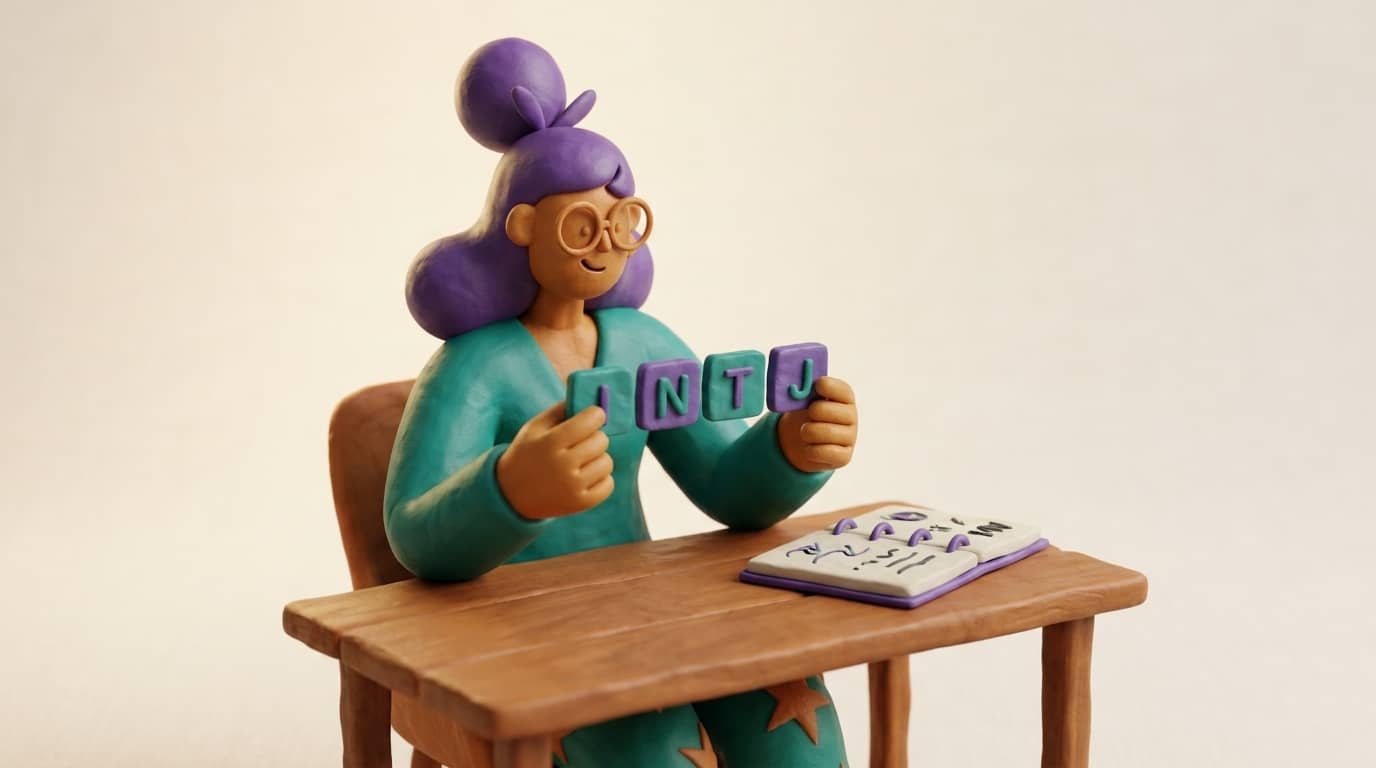
Is the MBTI accurate? Partly. Its test-retest reliability is 0.39-0.76 - meaning a meaningful share of people get a different type on a retake - and it has little predictive power for job performance or satisfaction. It's useful as shared vocabulary for cognitive style; it's weak as measurement. For a more rigorous read, the Big Five sits at 0.80-0.90 reliability with 23,000+ academic citations. The MBTI (Myers-Briggs Type Indicator) sorts cognitive preferences into 16 four-letter types across four binary axes: Introversion/Extraversion, Intuition/Sensing, Thinking/Feeling, Judging/Perceiving. NAVRYN measures it as one of 11 frameworks and reports the type plus a percentage breakdown per axis - so you see how strongly each preference holds, not just the letter.
The MBTI is the personality framework most people have heard of. It's also the one most people get half-right - usually by treating a four-letter code as a verdict. So before the plain-English walkthrough of what each letter means, the question that actually matters: is it accurate, and where should you trust it?
The short answer: MBTI is a useful read on cognitive style and a weak read on personality measurement. Its test-retest reliability runs 0.39-0.76 (a slice of people get a different type weeks later), and it has little predictive validity for outcomes like job performance (more on the research below). The frameworks that do the empirical heavy lifting are the Big Five and HEXACO (reliability 0.80-0.90). If you want one number to anchor your self-understanding, start with Big Five; if you want a memorable shorthand to talk about how you take in information and decide, MBTI earns its keep. The rest of this page is the detail behind that verdict, plus what NAVRYN reports when you take the assessment.
What does MBTI stand for?
MBTI stands for Myers-Briggs Type Indicator. The framework was developed in the mid-20th century by Katharine Cook Briggs and her daughter Isabel Briggs Myers, working from Carl Jung's earlier theory of psychological types. Jung proposed that people differ on a few core cognitive preferences. Briggs and Myers turned the theory into a measurable instrument and added a fourth axis Jung had only implied.
The result: four binary axes, 16 possible combinations, one four-letter code per person.
What the four axes measure
Each axis is a preference, not a hard line. Most people lean one way more than the other; very few people sit exactly on the middle.
Introversion (I) vs Extraversion (E). Where you direct attention and how you recover energy. Introverts orient inward and recharge alone. Extraverts orient outward and recharge with people. Both engage with the world; they just refuel from different sources.
Intuition (N) vs Sensing (S). How you take in information. Sensors prefer concrete data, present-tense observation, and what's directly in front of them. Intuitives prefer patterns, possibilities, and what something could become.
Thinking (T) vs Feeling (F). How you make decisions. Thinkers prioritise logic, consistency, and impersonal analysis. Feelers prioritise values, harmony, and the impact on people involved. Both are rational. They optimise for different things.
Judging (J) vs Perceiving (P). How you organise your outer life. Judgers prefer plans, structure, and decisions made early. Perceivers prefer flexibility, options, and decisions made late.
Combine the four letters and you get your type: INTJ, ENFP, ISFJ, ESTP, and so on.
Is the MBTI scientifically valid? What the research actually says
This is where the marketing diverges from the research.
The MBTI is widely used in workplaces, coaching, and education - by some estimates millions of people have taken it and thousands of organisations use it. It's also one of the more contested instruments in personality psychology. Two findings carry most of the criticism:
Reliability. Test-retest reliability - the rate at which someone's score holds steady across two sittings - ranges from 0.39 to 0.76 across published studies (McCrae & Costa, 1989; Boyle, 1995). That's useful but inconsistent; some axes hold up better than others, and a meaningful share of people retest into a different type within weeks.
Predictive validity. The traits MBTI measures have little demonstrated power to predict the outcomes people care about - job performance, job satisfaction, leadership effectiveness. As organisational psychologist Adam Grant has put it, the test's measured traits have "almost no predictive power" over how well you'll perform in a job or how satisfied you'll be in it. It describes a preference; it doesn't forecast much.
Big Five and HEXACO, by comparison, sit between 0.80 and 0.90 on reliability, and Big Five has over 23,000 academic citations behind it. They use continuous trait dimensions rather than binary preferences, which is part of why they're more stable. A person who scores 51% on a Big Five dimension shows up differently from a person who scores 92% on the same dimension. MBTI compresses both of them into the same letter.
The fair read: MBTI is a useful read on cognitive style. It is not the final word on personality. The frameworks that do the empirical heavy lifting are Big Five, HEXACO, Eysenck PEN, and OPQ - and if you want the why behind your behavior rather than the how, the Enneagram covers ground MBTI doesn't.
When MBTI is genuinely useful
The 16-type lens is most useful when you want a fast, memorable shorthand for how you take in information and make decisions.
It's good for:
- Communicating your working style to a new team
- Understanding where someone different from you is coming from
- Naming the cognitive trade-offs in a decision (e.g., "I'm an N - I lean toward possibilities. The data here is concrete; I should weight it more than I instinctively want to.")
- Framing relationship dynamics where one partner is a J and the other is a P
It is less useful when:
- You're trying to predict job performance (use Big Five or Caliper)
- You're working through a decision that touches your fears and motivations (use Enneagram)
- You're testing whether a candidate has the disposition for high-stakes work (use validated occupational instruments like OPQ)
The 16-type framing is a cognitive shortcut. Useful as a shortcut. Not as a final answer.
Limitations worth naming
Two limitations come up often in research and real-world use.
Binary forced-choice. MBTI sorts each axis into two boxes. Real personality lives on a spectrum. Someone who's 51% Thinking and 49% Feeling gets coded the same as someone who's 92% Thinking - and the two people will behave very differently. Frameworks that use percentages or trait scores capture this nuance better.
Type stability over time. A meaningful minority of users get a different type when they retake the assessment. Sometimes that's because their preferences have genuinely shifted across life stages. Sometimes it's because they were near the midpoint on an axis and a slightly different mood tipped the result. Either way, the four-letter code is more useful as a starting point than as a fixed identity.
What NAVRYN reports for MBTI
NAVRYN measures MBTI as one of 11 frameworks in a single 78-question assessment. The MBTI portion of the Personal Map reports:
- Your four-letter type (e.g., INTJ, ENFP, ISFJ)
- A percentage breakdown for each axis - for example, 78% Introverted, 62% Intuitive, 71% Thinking, 55% Judging. The percentages tell you how strongly each preference holds, which is usually more useful than the letter alone.
- What each preference means in context - paired with the rest of your profile so the read isn't generic
The percentage breakdown matters. It's the difference between knowing you're "an INTJ" and knowing you're "an INTJ whose Thinking preference is overwhelming and whose Judging preference is barely above the midpoint." Two INTJs with very different percentage profiles will work very differently in practice.
NAVRYN does not currently produce cognitive functions or type dynamics output. The percentage breakdown captures most of what those refinements try to surface, with less risk of overinterpretation.
How MBTI sits inside NAVRYN's 11 frameworks
MBTI is one of 11 lenses. The others - Big Five, HEXACO, DISC, Enneagram, 16PF, Eysenck Dimensions, OPQ Traits, Caliper Profile, Workstyle Factors, Strengths Themes - each answer a different question about who you are. MBTI tells you cognitive style. Big Five tells you traits. Enneagram tells you motivation. Strengths Themes tell you what you naturally lean on. Reading them together is what NAVRYN's Personal Map is built for.
For more on how the frameworks fit together, see the personality frameworks guide.
Take the assessment
If you've taken an MBTI test before and the four-letter result felt either too tidy or too vague, NAVRYN's version gives you the percentages plus 10 other lenses on the same data - in 15 minutes.
Take the NAVRYN free assessment - 11 frameworks, 78 questions, full report yours.